

The jobless figure reached 6.7 percent last month, up from 6.5 percent in October. More than half a million—533,000—were made unemployed during November. It's only the fourth time in the past 58 years that payrolls have fallen by more than 500,000 in a month. “The figures suggest the year-long U.S. recession may approach or even exceed the 1981-1982 downturn in severity, and support expectations that Federal Reserve officials will soon lower interest rates to levels not seen in a half century,” reports the Wall Street Journal. When marginally attached and involuntary part-time workers are included, the rate of unemployed or underemployed workers reached even higher: 12.5% last month, up 0.7 percentage point from October.
Saturday, December 6, 2008
WILLIAM AYERS SPEAKS
IN the recently concluded presidential race, I was unwillingly thrust upon the stage and asked to play a role in a profoundly dishonest drama. I refused, and here’s why.
Unable to challenge the content of Barack Obama’s campaign, his opponents invented a narrative about a young politician who emerged from nowhere, a man of charm, intelligence and skill, but with an exotic background and a strange name. The refrain was a question: “What do we really know about this man?”
Secondary characters in the narrative included an African-American preacher with a fiery style, a Palestinian scholar and an “unrepentant domestic terrorist.” Linking the candidate with these supposedly shadowy characters, and ferreting out every imagined secret tie and dark affiliation, became big news.
I was cast in the “unrepentant terrorist” role; I felt at times like the enemy projected onto a large screen in the “Two Minutes Hate” scene from George Orwell’s “1984,” when the faithful gathered in a frenzy of fear and loathing.
With the mainstream news media and the blogosphere caught in the pre-election excitement, I saw no viable path to a rational discussion. Rather than step clumsily into the sound-bite culture, I turned away whenever the microphones were thrust into my face. I sat it out.
Now that the election is over, I want to say as plainly as I can that the character invented to serve this drama wasn’t me, not even close. Here are the facts:
I never killed or injured anyone. I did join the civil rights movement in the mid-1960s, and later resisted the draft and was arrested in nonviolent demonstrations. I became a full-time antiwar organizer for Students for a Democratic Society. In 1970, I co-founded the Weather Underground, an organization that was created after an accidental explosion that claimed the lives of three of our comrades in Greenwich Village. The Weather Underground went on to take responsibility for placing several small bombs in empty offices — the ones at the Pentagon and the United States Capitol were the most notorious — as an illegal and unpopular war consumed the nation.
The Weather Underground crossed lines of legality, of propriety and perhaps even of common sense. Our effectiveness can be — and still is being — debated. We did carry out symbolic acts of extreme vandalism directed at monuments to war and racism, and the attacks on property, never on people, were meant to respect human life and convey outrage and determination to end the Vietnam war.
Peaceful protests had failed to stop the war. So we issued a screaming response. But it was not terrorism; we were not engaged in a campaign to kill and injure people indiscriminately, spreading fear and suffering for political ends.
I cannot imagine engaging in actions of that kind today. And for the past 40 years, I’ve been teaching and writing about the unique value and potential of every human life, and the need to realize that potential through education.
I have regrets, of course — including mistakes of excess and failures of imagination, posturing and posing, inflated and heated rhetoric, blind sectarianism and a lot else. No one can reach my age with their eyes even partly open and not have hundreds of regrets. The responsibility for the risks we posed to others in some of our most extreme actions in those underground years never leaves my thoughts for long.
The antiwar movement in all its commitment, all its sacrifice and determination, could not stop the violence unleashed against Vietnam. And therein lies cause for real regret.
We — the broad “we” — wrote letters, marched, talked to young men at induction centers, surrounded the Pentagon and lay down in front of troop trains. Yet we were inadequate to end the killing of three million Vietnamese and almost 60,000 Americans during a 10-year war.
The dishonesty of the narrative about Mr. Obama during the campaign went a step further with its assumption that if you can place two people in the same room at the same time, or if you can show that they held a conversation, shared a cup of coffee, took the bus downtown together or had any of a thousand other associations, then you have demonstrated that they share ideas, policies, outlook, influences and, especially, responsibility for each other’s behavior. There is a long and sad history of guilt by association in our political culture, and at crucial times we’ve been unable to rise above it.
President-elect Obama and I sat on a board together; we lived in the same diverse and yet close-knit community; we sometimes passed in the bookstore. We didn’t pal around, and I had nothing to do with his positions. I knew him as well as thousands of others did, and like millions of others, I wish I knew him better.
Demonization, guilt by association, and the politics of fear did not triumph, not this time. Let’s hope they never will again. And let’s hope we might now assert that in our wildly diverse society, talking and listening to the widest range of people is not a sin, but a virtue.
Friday, December 5, 2008
OBAMA STATEMENT ON NOVEMBER JOB LOSS
"The 533,000 jobs lost last month, the worst job loss in 34 years, is more than a dramatic reflection of the growing economic crisis we face. Each of those lost jobs represents a personal crisis for a family somewhere in America. Our economy has already lost nearly 2 million jobs during this recession, which is why we need an Economic Recovery Plan that will save or create at least 2.5 million more jobs over two years while we act decisively to maintain the flows of credit on which so many American families and American businesses depend.
"There are no quick or easy fixes to this crisis, which has been many years in the making, and it's likely to get worse before it gets better. But now is the time to respond with urgent resolve to put people back to work and get our economy moving again. At the same time, this painful crisis also provides us with an opportunity to transform our economy to improve the lives of ordinary people by rebuilding roads and modernizing schools for our children, investing in clean energy solutions to break our dependence on imported oil, and making an early down payment on the long-term reforms that will grow and strengthen our economy for all Americans for years to come," said President-elect Obama.
Wednesday, December 3, 2008
CHILLIN' WITH THE FRENCH; THEY MUST ALL BE OUTSIDE HAVING THEIR CIGARETTE

November 14-20, 2008
Tuesday, November 18, 2008
One Person, One Vote
A European Deputy attends a debate on the global financial crisis at a plenary session of the European Parliament in Strasbourg, France.
AND NOW, GOP "JACKASS CLASSIC"
| By: Attaturk Wednesday December 3, 2008 1:30 am |

As George W. Bush leaves the White House on a "high note" (but that's just the pisco sours talkin') blaming everyone but him for the nation's problems, let us note that the delusional gene runs strong in his party.
And to make Chris Wallace happy, let's return to that magical era of wide lapels, wider ties, and awesome audiotapes as Tricky Dick strode the country like a colossal ass:
Early December 1972:
Both men [Nixon and Kissinger] sometimes avoided the word "bombing." Instead, they talked of "the action."
As Nixon said, "Let's look at the action. We can't have any doubts about it."
Meanwhile,
...in a Dec. 9, 1972, conversation, Nixon told his daughter, Julie Nixon Eisenhower, that the purpose of the presidency is "to do good things every day."
Oh, for a secret taping system of the last eight years.
posted from firedoglake.com
A CONSENSUS EMERGES: BUILD, AND BUILD BIG
posted from truthout.org
Wednesday 26 November 2008
by: Eric Lotke, The Campaign for America's Future
by: Eric Lotke, The Campaign for America's Future

The Obama administration is being urged to pursue stimulus plans focused on infrastructure and jobs. (Photo: California High-Speed Rail Authority)
Everybody is saying the same thing. Stimulus plans don't mean tax rebates worth a few tanks of gas and a restaurant dinner. Stimulus plans means new roads and bridges, aid to states so they won't lay off nurses and teaching assistants, and a down payment on a new energy economy with windmills and commuter rail.
Most importantly, people have turned the corner on money. Stimulus will take real money, measured in hundreds of billions of dollars and percents of GDP. Low estimates put the investment at $300 billion. High ones reach $700 billion. Paul Krugman, with his hot new Nobel prize in economics, recommends "figure out how much help [you] think the economy needs, then add 50 percent."
The former but not future Treasury Secretary Lawrence Summers has changed his tune. No longer should stimulus be "targeted, timely and temporary." Now it should be "speedy, substantial and sustained." If he changes the first S to "strategic," he'll sound just like the Campaign for America's Future. "Strategic" points towards energy and education, investments that pay back over time.
Increasingly, even the deficit hawks recognize that this is not the time to worry about deficits. This is the time for action. To paraphrase FDR, when the house is burning, you don't fret about the cost of the hose.
Over the weekend, president-elect Barack Obama started to define what the New York Times labeled a Vast Economic Stimulus Plan.
"We'll be working out the details in the weeks ahead, but it will be a two-year, nationwide effort to jumpstart job creation in America and lay the foundation for a strong and growing economy. We'll put people back to work rebuilding our crumbling roads and bridges, modernizing schools that are failing our children, and building wind farms and solar panels, fuel-efficient cars and the alternative energy technologies that can free us from our dependence on foreign oil and keep our economy competitive in the years ahead."
He is exactly right, and he's been saying this since the campaign.
In June he told the U.S. conference of Mayors:
"Now is not the time for small plans. Now is the time for bold action to rebuild and renew America. We've done this before. Two hundred years ago, in 1808, Thomas Jefferson oversaw an infrastructure plan that envisioned the Homestead Act, the transcontinental railroads, and the Erie Canal. One hundred years later, in 1908, Teddy Roosevelt called together leaders from business and government to develop a plan for a 20th century infrastructure. Today, in 2008, it falls on us to take up this call again - to re-imagine America's landscape and remake America's future. That is the cause of this campaign, and that will be the cause of my presidency."
Back then he was estimating expenditures in the $150 billion range - and nowadays that's rounding error. But back then the Dow was at 12,000 and 1.5 million more people had jobs. It's nice to see him up the ante.
The American people are behind this too. A June survey by Hart Research showed a country that wants more than quick stimulus. Nearly two-thirds (63 percent) of voters think the economy is facing "long-term, structural economic problems." Only one-third (30 percent) say it is a "short-term economic downturn."
Investing in physical infrastructure is among the most popular of long-term solutions. A June survey by Rockefeller Foundation found 82 percent support for "increasing government spending on things like public-works projects to help create jobs." Reconstruction will take time and exceed the limits of a single budget cycle - but for long term solutions to long term problems, you don't "pay as you go." You invest over time.
We discussed all of this last week at our conference on Real Investment in America. I wrote all about it in our snazzy new report, The Investment Deficit.
Build, baby, build. The consensus is emerging.
Tuesday, December 2, 2008
THE GREAT CRASH OF 2008
Monday 01 December 2008
By: Robert Reich, Robert Reich's Blog

While the US economy has only recently been officially deemed as in recession, many Americans have been struggling with poverty for a long time. (Photo: Stephen Shames, 1985)
If this isn't a Great Crash I don't know how to define one. Stocks were down another 7 percent today. Since the peak of last year, major stock indexes have dropped 47 percent. We're in range of the Great Crash of 1929.
Why is the Great Crash of 2008 happening? First, because investors are beginning to understand the enormity of the bubble economy that began to form in the late 1990s when all constraints were lifted on borrowing in order to buy everything that was assumed to be increasing in value - starting with houses and including securities and shares of stock themselves. So-called "margin requirements," first instituted in the wake of the Great Crash of 1929, were all but abandoned, as big banks and hedge funds found ways around them.
Even more important, investors are starting to fathom the emptiness of American consumers' wallets. Retail sales last Friday and Saturday - the first days of the Christmas buying season - were disappointing. Had retailers not discounted to the point of taking losses, sales would have been abysmal. In other words, consumers have gone on strike.
Why have they gone on strike? Not because of the difficulty of getting credit. Most consumers can barely afford to pay the interest charges on the debt they're already carrying. Consumers have gone on strike because their earnings haven't kept up. The recovery that officially ended December, 2007 (the National Bureau of Economic Research now tells us) was the first on record in which median earnings declined, adjusted for inflation. Since then, many people have also lost their jobs or are working part time when they'd rather be working full time, or else know they're in danger of losing their jobs.
The speculative bubble still has some air in it; asset values will continue to drop before they hit bottom. That will take at least a year, possibly two. But don't expect asset values to bounce substantially back, even then. The only way to revive Wall Street is to revive Main Street, and the only way to accomplish this is to get America back on the course of rising median incomes.
--------
Robert Reich is the nation's 22nd Secretary of Labor and a professor at the University of California at Berkeley. His latest book is "Supercapitalism."
THIS ONE SPEAKS FOR ITSELF....NO HEADLINE NEEDED
graciously contributed to Chill Baby, Chill by Terry Kidder


Back in the 1929 Financial Crash it was said that some Wall Street Stockbrokers and Bankers JUMPED from their office windows and committed suicide when confronted with the news of their firms and clients financial ruin . . . Many people were said to almost feel a little sorry for them . . . . .
In 2008 the attitude has changed somewhat:
BAILOUT MONITOR SEZ TREASURY HAS NO EFFIN' CLUE
posted from firedoglake.com
| by: Christy Hardin Smith Tuesday December 2, 2008 6:00 am |

Why am I not surprised? Treasury bailout overseer sees no real plan, no coherence, nothing strategic as yet in the billions of dollars pouring forth out of our taxpayer pockets and into failing corporate coffers. Via NYTimes:
...the government still does not seem to have a coherent strategy for easing the financial crisis, despite the billions it has already spent in that effort.
Elizabeth Warren, the chairwoman of the oversight panel, said...that the government instead seemed to be lurching from one tactic to the next without clarifying how each step fits into an overall plan.
“You can’t just say, ‘Credit isn’t moving through the system...You have to ask why.”
Having some strategic planning and contemplating implications for the long haul might be the teensiest bit useful, don't you think?
Instead, we have outright panic maneuvers designed for public CYA. And stalling until January so the problem can be fobbed off...but little else.
Ezra discussed Krugman's smackdown of conservative deficit hawks and the value of public works expenditures. Krugman will be here live tomorrow at noon PT/3 pm ET for a book salon about "The Return Of Depression Economics And The Crisis of 2008." We couldn't host him at a better time, because everything old is new again:
Only much later would those same distinctive characteristics -- the cozy relationship between government and business, the extension of easy credit by government-guaranteed banks to closely allied companies -- come to be labelled crony capitalism and seen as the root of economic malaise. (p. 60)
Krugman is talking about Japan's recession in the 1990s, but it does have a certain familiar ring, doesn't it?
Economic signs are worsening, pointing to a longer recession, and every time Hank Paulson speaks the market tanks. With no coherent plans, shouldn't we all be asking why in the hell they continue to throw our money at problems they haven't bothered to think about beyond "shit! we have to look busy, throw more money on the pyre!"
CLINTON'S FOREIGN POLICY CABINET

Photo by Scott Olson/Getty Images
“Clinton advisers are assisting Obama’s transition team and serving on several advisory committees. But staff is destiny, and there are conflicting reports about how much latitude Clinton will have to bring her own team aboard.”
THE GREAT RECESSION

Not only is the U.S. economy now officially in recession, but it has been so since December 2007, according to the National Bureau of Economic Research. It's the first time in the postwar era that the euro zone, Japan, and the United States have all simultaneously been in recession. It also makes President Bush the first executive since Nixon to oversee two recessions. "We're going on 12 months already, and we're just getting started," one economist told Bloomberg. The chairman of the Institute for Supply Management said, "This may be referred to as the Great Recession." 1.2 million jobs have been lost so far this year, and the 325,000 that were probably lost in November are the most in any month since the last recession.
GREGORY GETS MEET THE PRESS

The Huffington Post’s Danny Shea was the first to report that the moderator slot on NBC’s Meet the Press will go to David Gregory. Gregory’s name has circulated, along with NBC’s Chuck Todd and Andrea Mitchell, since Time Russert’s death in June. Before ascending to the host’s chair on various NBC programs, Gregory was a feisty presence on the White House beat, often enraging conservatives with his questions to Bush press officials. Brokaw will reportedly leave the show this weekend after interviewing Barack Obama. The Politico's Mike Allen even has a vote of confidence from Ari Fleischer, who calls Gregory "nothing but fair."
CLINTON'S FRESH START
posted from fivethirtyeight.com
While we continued to tour Georgia, the dominant political news of the day was the official announcement from Barack Obama that he will nominate Hillary Clinton for Secretary of State. Regardless of one's opinion of the pick, it's clear Clinton has a golden opportunity here to refresh her image not only within the Democratic Party, but with the country as a whole.
Her future presidential ambition is now inextricably bound to Barack Obama's success as President. From Obama's perspective, harnessing that energy to work in his favor was apparently worth the risk of the horrendous message discipline the Clinton machine brings with it wherever it goes. At first blush, it wouldn't seem like a position endlessly scrutinized by foreign governments would be the ideal place for a political group that cannot keep a secret.
But most Democrats seem willing to give Obama's judgment in the matter the benefit of the doubt. In a battle between skepticism of Clinton and trust of Obama, right now most of Obama's supporters who mistrust Clinton seem willing to trust Obama's judgment.
Not that they have a choice. Obama's the boss.
In other news, with Janet Napolitano's expected successful appointment to Homeland Security, Republican Secretary of State Jan Brewer will take the vacant governor's seat. Hillary Clinton's Senate seat will be appointed by Democratic Governor David Paterson. This is the third Democratic Senate seat that needs to be filled. Ted Kaufman will replace Joe Biden in Delaware, and in Illinois Rod Blagojevich will name a replacement for Barack Obama.
CONSENSUS EMERGING ON UNIVERSAL HEALTHCARE
Monday 01 December 2008
by: Noam N. Levey, The Los Angeles Times

Health care reform is near the top of the agenda for the new administration. (Photo: Stephen J. Serio)
Washington - After decades of failed efforts to reshape the nation's healthcare system, a consensus appears to be emerging in Washington about how to achieve the elusive goal of providing medical insurance to all Americans.
The answer, say leading groups of businesses, hospitals, doctors, labor unions and insurance companies - as well as senior lawmakers on Capitol Hill and members of the new Obama administration - is unprecedented government intervention to create a system of universal protection.
At the same time, those groups, which span the ideological and political spectrum, largely have agreed to preserve the employer-based system through which most Americans get their health insurance.
The idea of a federal, single-payer system patterned on those in Europe and Canada, long a dream of the political left, is now virtually off the table.
Rejected as well is the traditionally conservative concept, championed by Sen. John McCain (R-Ariz.) during the presidential campaign, of reforming healthcare mainly by giving incentives for more Americans to buy insurance on their own.
There also is a widespread understanding that any expansion of coverage must be accompanied by aggressive efforts to bring down costs and reward quality care. And key players in the healthcare debate increasingly back a massive investment of taxpayer money for healthcare reform despite the burgeoning budget deficits.
Beyond those areas of basic agreement, the details of what would be one of the most momentous changes in domestic policy since World War II remain vague.
As a presidential candidate, Barack Obama embraced both expanded insurance coverage and preservation of the job-centered system, but since he won the White House he has provided few specifics about his plans once he takes office.
Disagreements over specifics could again lead to a stalemate. Even the most sanguine advocates of sweeping reform concede that difficult negotiations lie ahead.
But what is taking shape is a debate very different from previous discussions about what America's healthcare system should look like.
"A lot has changed," said Karen Ignagni, president of America's Health Insurance Plans, or AHIP, a leading trade group whose members helped kill the Clinton administration's healthcare campaign in the early 1990s.
AHIP is participating in talks with other interest groups to build consensus before Obama takes office in January and Congress begins debating any healthcare legislation.
Unresolved Issues
Among the issues to be decided as more concrete proposals emerge in the months ahead is whether the roughly 46 million uninsured people in the U.S. will be pushed to buy private coverage or will be enrolled in a government insurance program, as some consumer groups want.
Hospitals and doctors fear another public program would reduce what they are paid, as Medicare and Medicaid have done. Insurers worry they could lose customers to the government.
Also unresolved is what mechanisms might be created to force individuals or businesses to get insurance, both potentially contentious subjects.
And few have tackled how the government will control costs and set standards of care, proposals that raise the unpopular prospect of federal regulators dictating which doctors Americans can see and what drugs they can take.
"There are some very big questions and some very big stumbling blocks," said Stuart Butler, vice president for domestic policy at the conservative Heritage Foundation, who has been watching the healthcare debate for three decades.
"Once you get into the details, the consensus is going to vanish pretty quickly, I suspect," he said.
At the same time, advocates for a single-payer system, including the California Nurses Assn., have vowed to continue pushing the idea next year along with many Democrats on Capitol Hill.
Republican lawmakers, still reeling from their election day losses, have signaled discomfort with a major expansion of government spending, a position many in the GOP hope will help return the party to power.
"Increasing access for the uninsured is not going to come cheap," Sen. Charles E. Grassley (R-Iowa) said at a recent hearing on healthcare reform. "And it's clear to me that our economy cannot stand much further deficit spending."
Nonetheless, the current agreement on principles contrasts markedly with previous reform efforts. Today, many of the key players in the debate see the importance of preserving elements of the current healthcare system that many Americans say they like.
"There is a growing understanding that you have to give people choice and you can't take away what they have," said Ron Pollack, head of Families USA, an influential advocacy group for healthcare consumers that is working with a diverse collection of interest groups to build consensus. "One of the big no-nos is that you must not ever threaten the coverage that people have."
The Clinton Effort
Fifteen years ago, there was much less agreement about preserving an employment-based system that now insures about 177 million people.
Opponents of President Clinton's plan were able to sink it by raising the specter that government would take away consumers' choices in a new system that would force them into inferior health insurance.
But now the prospect of bold government action to address the healthcare crisis appears to have been accepted far more broadly by many of those involved in the debate.
Even business leaders traditionally wary of government intervention now are pushing for the federal government to act decisively to reshape the healthcare marketplace - in large part because of the increasing burden imposed on them by rising costs.
"Doing this piecemeal is not going to work," said Todd Stottlemyer, president of the National Federation of Independent Business, which was also instrumental in defeating the Clinton plan.
Many involved in the healthcare debate, including Democratic lawmakers and members of Obama's team, also see healthcare reform as part of a broader economic picture.
Democratic leaders on Capitol Hill have begun sketching out plans for healthcare reform that, like Obama's plan, preserve the employer-based system and create a new system for those without insurance.
Last month, Senate Finance Committee Chairman Max Baucus (D-Mont.) outlined such a plan in an 87-page white paper titled "Call to Action." Similar approaches have been endorsed by House Democrats.
In contrast, the Clinton administration drew up its healthcare reform plan with little involvement from congressional Democrats. In the Senate, then-New York Democrat Daniel Patrick Moynihan, who was chairman of the finance committee at the time, actively resisted the idea of sweeping change in healthcare.
There are no signs of a similar rift today, said Jacob Hacker, a political scientist at UC Berkeley who has written a book about the failed Clinton effort.
"Possibly more important than policy agreements," Hacker said, "is the fact that the political forces now are in alignment."
Monday, December 1, 2008
FRENCH FACE OF THE DAY

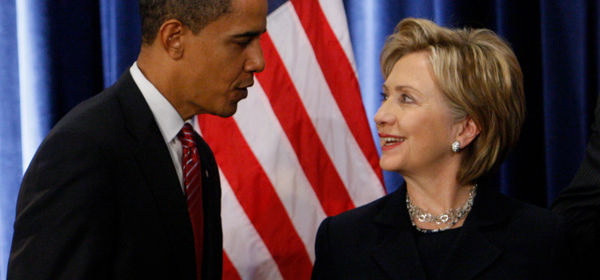
Posters noticed by a Dish reader in Paris this weekend. Sarkozy is nothing if not shameless.
TRANSITION OR COUP D'ETAT?
Sunday 30 November 2008
by: Kevin Berends, t r u t h o u t | Perspective

(Photo: Mark Wilson / Getty Images)
During the transition period there is a silent coup d'état occurring inside the federal government in the form of last-minute firings and dubious personnel placements. The easy response to this practice is: "That always happens during the transition period and it isn't even newsworthy. That's how Washington works - always has, always will." Perhaps, but considering how pervasively the Bush administration has flouted every branch of government, from ignoring Congressional subpoenas, to ignoring Supreme Court rulings, to violating the Geneva Conventions, to profuse and legally feeble signing statements - it's clear that embedding operatives loyal to the party and policies jettisoned by the voters in the election is tantamount to laying mines throughout the government.
As if this isn't enough, while the outgoing administration lays mine fields to sabotage President-elect Obama's initiatives that could threaten the status quo, it is also terminating outstanding federal employees whom the current administration can assume, correctly, would be supportive of the new president's policies. In the case of Dr. Marsha Coleman-Adebayo, who received her Notice of Proposed Removal from the Environmental Protection Agency on October 30, 2008, the message is clear: remove the person who has demonstrated like no other person within the EPA a determination to ensure that what the agency protects is the environment (as opposed to the corporations and other interests whose practices harm the environment but yield staggering profits) - and a chilling effect on other conscientious workers will have been achieved. Dr. Coleman-Adebayo's landmark court victory in Coleman-Adebayo v. Browner (former EPA Administrator Carol Browner,) represents the most serious challenge the status quo has ever seen. Thus, decapitate the head and the uncontrolled beast of conscientious federal workers will fall. Last week, this particular purge prompted a letter to beleaguered outgoing EPA Administrator Stephen Johnson from Congressional Liaison to the White House Chris Van Hollen, urging reconsideration of Dr. Coleman-Adebayo's firing, and the postponement of any further action until the transition is complete.
This poisonous cocktail of embedding shills within the federal government while terminating exemplars imitates the old Soviet-style purges, where dissidents were forcibly removed and expelled to the Gulag. For courageous federal employees, however, our Siberia is a fate of poverty and disenfranchisement. Further, the embedding and termination process allows Bush-sympathetic bureaucrats - whose allegiance is to the failed president's cronyism above concerns for an endangered environment - to keep "political insiders" within the bureaucracy to sabotage the Obama administration's best efforts to bring the EPA back into sync with the best scientific evidence we have - that there is no time to waste before environmental damage will reach the point of no return.
In the midst of severe economic downturn, terminated federal employees are sure to find themselves on the street without the possibility of future employment, because the government refuses, in many cases, to provide favorable recommendations for them. In many documented instances, the only thing these employees are "guilty" of was having blown the whistle on illicit practices within the federal system. Yet their firing often results in a twenty- to thirty-year gap in their employment history, because the "scarlet letter" of being fired discourages others from hiring them. This, of course, has cascading effects where many fired employees have lost their homes and have been added to the ranks of the unemployed and to the rising number of people having to rely on welfare to survive. While this is designed to produce a chilling effect and spread a cold climate of fear and intimidation throughout the federal system, it will do nothing to cool an at-risk planet.
Employees fearful that talking to the press will lead to them being identified and fired are controllable employees. This is where we need to give the devil his do. President Bush signed the No FEAR Act into law so that such retaliation and discrimination could be banished from the status quo. Or at least so it would appear to have been. Truth be known, No FEAR has been easily circumvented, for lack of enforceable code. But that's where the No FEAR II and Federal Disclosures Acts could come in - at exactly the right moment when the electorate, its new president, and a willing Congress - quite apart from looking the other way while decent people have their careers destroyed - could erase decades of business as usual.
Both acts would put teeth into existing Whistleblower protection law: by holding managers who tolerate discrimination, retaliation - and eleventh-hour purges - personally accountable for those crimes; by expediting claims against those managers through the courts, and by financial incentives for whistleblower attorneys.
The day when the old familiar rejoinder of "This is what always happens during the transition period" is a thing of the past and is as close as being within reach of Congress's vote and the president's pen.
QUOTE OF THE DAY
“The triumvirate of Gates, Clinton and Jones to lead Obama's national security team instills great confidence at home and abroad, and further strengthens the growing respect for the president-elect's courage and ability to exercise sound judgment in selecting the best and the brightest to implement our nation's security policies.”
Republican Senator John Warner
HOW OBAMA CAME TO LOVE HILLARY
Barack Obama's announcement today of Hillary Clinton as his secretary of state will be one of the year's biggest surprises. Politico runs an article looking at the development of Obama's and Clinton's relationship. It began cordially enough in the Senate, when Obama said he would look to Clinton as a model of how to handle political celebrity, but chilled in 2006 when Obama began preparing to run for president and Clinton thought he had not put in his time. The details of their primary battle are, by now, well hashed, but "I think that the people around each disliked the other candidate more than they ever disliked each other," says one Democrat. Obama repeatedly brought up Clinton as a VP possibility but was rebuked by his team. Throughout the fall, as Clinton campaigned for Obama in Pennsylvania and Florida, and with women voters, she earned his trust.
Tuesday, November 25, 2008
DAILY KOS LAUNCHES BLOG TO WATCH CONGRESS
Prominent writers for DailyKos, the country's top liberal blog, are launching a new site to scrutinize and pressure the Democratic Congress.
This week, as most politicos focus on appointments in the incoming Obama administration, DailyKos bloggers began a "soft launch" for Congress Matters, which promises a "community-based political watch party" for Democrats on Capitol Hill.
"It'll be a place where we'll try to explain Congressional rules and procedure so that the netroots community gets a better handle on it and can become more effective advocates for their priorities," said David Waldman, an attorney and former Congressional aide who blogs on the front page of DailyKos under the name Kagro X.
While netroots activists often call Congress, Waldman explained, "the reality is that by the time a bill gets to the floor, it's almost too late to have any real impact by calling." The new blog will tap DailyKos' audience and brand, he told The Nation, with the aim of "getting people involved earlier in the process, teaching them about committee markups and the amendment process to eventually put them in a position where they can intervene at the critical points in the process -- the way lobbyists have learned to do." 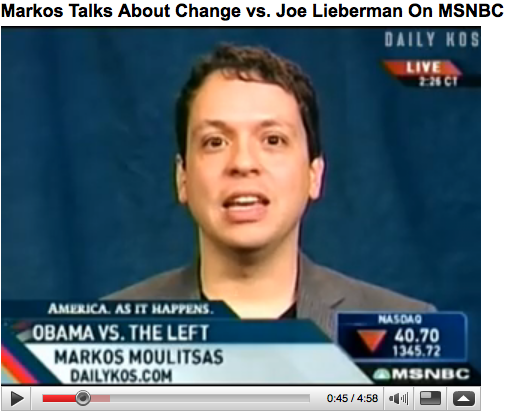
Another Hill staffer turned blogger, Joan McCarter, penned an open letter to the Democratic Congressional leadership after the election, and posted it on DailyKos' coveted front page real estate. Even after election fever subsided, the site remains the eighth most popular blog in the country. (It beats techie favorites like the Google blog, better-funded news sites including CNN ticker, and even the traffic powerhouse ICanHasCheezburger, which posts pictures of cats.) McCarter pressed for Iraq withdrawal, economic renewal, health care reform and dismantling the unitary executive. "We've been in election land for so long on the blog that the community needs to regroup and change gears," she told The Nation.
The new blog arrives at at time when the traditional media is questioning the netroots' influence after the Democratic Senate Caucus embraced Joe Lieberman, and as some bloggers worry that Obama's initial appointments look more like a third Clinton term than bottom-up change.
This venture rebuffs Washington's penchant for measuring clout and the (understandable) urge to assess a new president. Instead, the Kossacks are bearing down further on legislative activism. In the end, it might even be a good route to influence, too.
The NEVER-ENDING BAILOUT
The Federal Reserve announced today two new programs to fight the financial crisis by increasing lending to consumers and small businesses and supporting the market for mortgage-backed securities. The Fed will buy up to $600 billion of mortgage-backed securities from Fannie Mae and Freddie Mac, in order to boost the availability of credit for purchasing houses. This means the Fed is directly subsidizing lower mortgage rates, as opposed to tinkering with them indirectly via interest rates. The Fed and the Treasury will also lend $200 billion to holders of assets backed by car, credit card, student, and small business loans. According to Henry Paulson, “It gives institutions liquidity and it’s clearly direct lending that will help consumers.”
RUSSIAN PREDICTS DECLINE AND BREAKUP OF AMERICA
posted from Drudge Report
A leading Russian political analyst has said the economic turmoil in the United States has confirmed his long-held view that the country is heading for collapse, and will divide into separate parts.
Professor Igor Panarin said in an interview with the respected daily IZVESTIA published on Monday: "The dollar is not secured by anything. The country's foreign debt has grown like an avalanche, even though in the early 1980s there was no debt. By 1998, when I first made my prediction, it had exceeded $2 trillion. Now it is more than 11 trillion. This is a pyramid that can only collapse."
The paper said Panarin's dire predictions for the U.S. economy, initially made at an international conference in Australia 10 years ago at a time when the economy appeared strong, have been given more credence by this year's events.
When asked when the U.S. economy would collapse, Panarin said: "It is already collapsing. Due to the financial crisis, three of the largest and oldest five banks on Wall Street have already ceased to exist, and two are barely surviving. Their losses are the biggest in history. Now what we will see is a change in the regulatory system on a global financial scale: America will no longer be the world's financial regulator."
When asked who would replace the U.S. in regulating world markets, he said: "Two countries could assume this role: China, with its vast reserves, and Russia, which could play the role of a regulator in Eurasia."
Asked why he expected the U.S. to break up into separate parts, he said: "A whole range of reasons. Firstly, the financial problems in the U.S. will get worse. Millions of citizens there have lost their savings. Prices and unemployment are on the rise. General Motors and Ford are on the verge of collapse, and this means that whole cities will be left without work. Governors are already insistently demanding money from the federal center. Dissatisfaction is growing, and at the moment it is only being held back by the elections and the hope that Obama can work miracles. But by spring, it will be clear that there are no miracles."
He also cited the "vulnerable political setup", "lack of unified national laws", and "divisions among the elite, which have become clear in these crisis conditions."
He predicted that the U.S. will break up into six parts - the Pacific coast, with its growing Chinese population; the South, with its Hispanics; Texas, where independence movements are on the rise; the Atlantic coast, with its distinct and separate mentality; five of the poorer central states with their large Native American populations; and the northern states, where the influence from Canada is strong.
He even suggested that "we could claim Alaska - it was only granted on lease, after all." Panarin, 60, is a professor at the Diplomatic Academy of the Russian Ministry of Foreign Affairs, and has authored several books on information warfare.
A leading Russian political analyst has said the economic turmoil in the United States has confirmed his long-held view that the country is heading for collapse, and will divide into separate parts.
Professor Igor Panarin said in an interview with the respected daily IZVESTIA published on Monday: "The dollar is not secured by anything. The country's foreign debt has grown like an avalanche, even though in the early 1980s there was no debt. By 1998, when I first made my prediction, it had exceeded $2 trillion. Now it is more than 11 trillion. This is a pyramid that can only collapse."
The paper said Panarin's dire predictions for the U.S. economy, initially made at an international conference in Australia 10 years ago at a time when the economy appeared strong, have been given more credence by this year's events.
When asked when the U.S. economy would collapse, Panarin said: "It is already collapsing. Due to the financial crisis, three of the largest and oldest five banks on Wall Street have already ceased to exist, and two are barely surviving. Their losses are the biggest in history. Now what we will see is a change in the regulatory system on a global financial scale: America will no longer be the world's financial regulator."
When asked who would replace the U.S. in regulating world markets, he said: "Two countries could assume this role: China, with its vast reserves, and Russia, which could play the role of a regulator in Eurasia."
Asked why he expected the U.S. to break up into separate parts, he said: "A whole range of reasons. Firstly, the financial problems in the U.S. will get worse. Millions of citizens there have lost their savings. Prices and unemployment are on the rise. General Motors and Ford are on the verge of collapse, and this means that whole cities will be left without work. Governors are already insistently demanding money from the federal center. Dissatisfaction is growing, and at the moment it is only being held back by the elections and the hope that Obama can work miracles. But by spring, it will be clear that there are no miracles."
He also cited the "vulnerable political setup", "lack of unified national laws", and "divisions among the elite, which have become clear in these crisis conditions."
He predicted that the U.S. will break up into six parts - the Pacific coast, with its growing Chinese population; the South, with its Hispanics; Texas, where independence movements are on the rise; the Atlantic coast, with its distinct and separate mentality; five of the poorer central states with their large Native American populations; and the northern states, where the influence from Canada is strong.
He even suggested that "we could claim Alaska - it was only granted on lease, after all." Panarin, 60, is a professor at the Diplomatic Academy of the Russian Ministry of Foreign Affairs, and has authored several books on information warfare.


QUOTE OF THE DAY
"One of the reasons the U.S. is in such deep trouble is that it has stopped being smart — turning its back on excellence, sophistication and long-term planning — in its public policies and corporate behavior. We’ve seen it in Iraq, in New Orleans, in the fiscal policies of the Bush administration, in the scandalous neglect of public education, in the financial sector meltdown, the auto industry and on and on. We’ve lionized dimwits. And now we’re paying the price."
Bob Herbert, New York Times - 11/25/08
GUANTANAMO JUSTICE
By Marjorie Cohn, Jurist

Judicial branch rejects Bush administration detention policies. (Photo: Brennan Linsley / AP)
READ POST HERE»
A WARNING FROM REAGAN'S ECONOMIST
Why the proposed $700 billion stimulus plan could drive the country to economy ruin.
posted from dailybeast...written by Arthur Laffer, former Reagan Economic Adviser
As you read this, our government is committing enormous sums of money above and beyond normal spending, solely to stimulate the economy and prop up failing companies and markets. These additional sums are huge by any reasonable measure, with estimates as high as $3 trillion in an economy with a GDP of about $15 trillion.
Here’s the bottom line: Instead of making things better, increased spending will only drive our economy further into the ground.
And there is still a lot more spending to come. First it was a $170 billion stimulus package in February of 2008, then material add-ons to both the housing and agricultural bills, followed by Federal Reserve asset swaps with Bear Stearns and a bailout of AIG (which, by the way, isn’t over yet) and then came the debt guarantees of Fannie Mae and Freddie Mac.
There is no tooth fairy. Every dollar given to someone comes from someone else.
Shortly after that, the administration anted up $700 billion in a bailout package, and now Obama, Reid, Pelosi and Bernanke want another stimulus package of $300 billion. Just this week the powers that be are debating bailouts for Michigan’s auto industry. With the slowdown in the economy, tax receipts are now projected to fall sharply. The logic here is totally upside down, and each new measure, far from helping the economy, does enormous damage.
It is true, as the proponents of these stimulus packages argue, that recipients of government checks will spend more than they otherwise would have spent. And, that increased spending will have a multiplier effect increasing spending even further. But this is only part of the story.
The government can only transfer resources; it can’t create resources. There is no tooth fairy. Every dollar given to someone comes from someone else. The government can’t bail some people out of trouble without putting other people into trouble, plus a hefty “toll for the troll.”
In the case of last February’s stimulus package, the government literally borrowed an extra $170 billion and at the same time sent out checks to the transfer recipients totaling $170 billion. The result was a $170 billion increase in the amount of bonds held by the public, accompanied by a $170 billion increase in the current value of future taxes to pay interest and principle on the additional debt.
From the standpoint of accounting, the government is $170 billion further in the red, and taxpayers are liable for an additional $170 billion worth of taxes. Therefore, for every dollar of transfer payment there’s at least an equivalent dollar of future tax liabilities. Those people with the increased tax liabilities will spend less, thereby dis-employing people who had been supplying them with goods they’ll no longer buy. And the reduction in spending of those with higher tax liabilities will lead to a multiplied reduction in total spending equal to and fully offsetting the increase in total spending from the recipients of government checks. There is no stimulus from the stimulus programs!
To see this point more intuitively, imagine what the “stimulus effect” would be if they borrowed the $700 billion from the same people to whom they gave the $700 billion and then promised to raise their taxes by enough in the future to pay off their bonds. Where’s the stimulus in that?
This point is hugely important. For the proponents of increased government spending to argue that their policies will increase output, it is absolutely essential that the increased spending by transfer recipients more than offset any decline in spending by others. If the income effects of fiscal policy net to zero, there is no rationale for these spending policies. And, the income effects of fiscal policy do indeed net to zero.
The diffuse and imprecise nature of just who bares the increased tax liabilities makes the point difficult to understand. We all know who benefits from government programs: mortgage holders, undercapitalized banks, auto companies, low-income earners and the like. But who bears the increased tax burden? That’s a far trickier question, the answer to which I don’t have. But in the aggregate I do know that for every beneficiary of government spending there is someone who has to pay for it. As Milton Friedman so wisely noted, “There ain’t no such thing as a free lunch.”
What I don’t really know is just how far this process can go and just what it will take to stop this vicious cycle. Combine the unintended consequences of a flawed model with a crashing economy in ever more desperate need of beneficial policies, and the results are lethal. The old adage “if you don’t like government problems just wait till you see government solutions” has never been truer.
Dr. Laffer is chairman of Laffer Associates and co-author of "The End of Prosperity: How Higher Taxes Will Doom the Economy—If We Let it Happen," recently published by Threshold. He’s best known in economics for the Laffer curve, showing the relation between tax rates and revenue take.
THE BUSH PARDONS BEGIN
The moment many have been anticipating has arrived: Bush has begun the traditional end-of-term presidential pardons. In today’s first round, he granted 14 pardons and two commutations, but none of the possible big names—Plame outer Scooter Libby, junk bond king Michael Milliken, or Republican congressmen in prison for corruption—were among them. Instead, small-time criminals got their criminal records wiped clean of convictions for drug dealing, bank embezzling, and improper food stamp use. “American Taliban” John Walker Lindh and imprisoned media baron Conrad Black also have petitioned the Justice Department’s Office of the U.S. Pardon Attorney, but they might not be as lucky as those pardoned today: “Bush has not been known to be generous with his power to wave away a criminal record,” The Hill reports “The president has now pardoned 171 individuals and commuted sentences for eight people, a relatively small number compared to past administrations.”
Monday, November 24, 2008
QUOTE OF THE DAY
“We are tied together in the single garment of destiny, caught in an inescapable network of mutuality. And whatever affects one directly affects all indirectly. For some strange reason, I can never be what I ought to be until you are what you ought to be. And you can never be what you ought to be until I am what I ought to be. This is the way God’s universe is made; this is the way it is structured.”
Martin Luther King Jr.
CITI SAVED

A plan to save Citigroup has emerged. Citi will absorb the first 10 percent of losses—about $29 billion—from its portfolio of risky assets, which includes mortgages, credit cards, commercial real-estate, and big corporate loans. The United States government will stand behind the remaining 90 percent of losses, which could eventually cost $249 billion. In addition, the government will buy $27 billion of preferred stock in Citi and receive dividends at an annual rate of 8 percent. Citigroup's CFO says the plan was created in a "plain vanilla flavor" so that it can be applied to other institutions.
PROJECTION BY NATE SILVER: FRANKEN TO WIN RECOUNT IN MINNESOTA BY 27 VOTES
posted from fivethirtyeight.com
As we wrote yesterday evening, the ever-increasing number of challenged ballots in Minnesota is making it more and more difficult to determine the extent to which Al Franken is in fact gaining ground in the state's recount process. An analysis of precinct-by-precinct returns available on the Secretary of State's website, however, suggests that Franken's position is somewhat stronger than it appears, and that he may in fact be the favorite to prevail in the recount process.
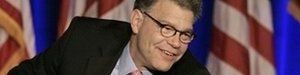
Consider the following. In precincts where no challenges have been issued (these are the only precincts in which, in some sense, the results of the recount can be considered to be final and "official") Franken has gained a total of 34 votes, and Coleman a total of 6 votes, for a net gain by Franken of 28 votes. Moreover, in precincts where just 1 challenge has been issued, Franken has gained a net of 31 votes on Coleman, and in precincts where exactly 2 challenges have been issued, Franken has gained a net of 32 votes on Coleman.
By contrast, in precincts where 5 or more ballots have been challenged between the two campaigns, Coleman has gained a net of 57 votes on Franken.
In other words, the fewer the number of challenged ballots, the better Franken is doing, and the higher the number of challenged ballots, the worse he is doing; the relationship is in fact quite strong.Precinct-Level Returns Analysis
It is not an accident, then, that as the number of challenges has increased with each day of the recount, Franken's momentum appears to have stalled out. Very probably, a majority of the challenges are coming from Franken's pile. This is somewhat irrespective of which campaign actually instigates the challenge, since as we suggested yesterday, a potential Franken undervote could be the subject of a challenge from either campaign depending on the initial ruling of the local elections judge.
# Challenges n Franken Coleman Net
0 2233 +34 +6 Franken +28
1 419 -94 -125 Franken +31
2 154 -90 -122 Franken +32
3-4 133 -157 -171 Franken +14
5-9 59 -158 -116 Coleman -42
10+ 26 -156 -141 Coleman -15
We can address this phenomenon more systematically by means of a regression analysis. In the regression, we are attempting to predict a variable I've defined as franken_net, which is the net gain by Franken per 10,000 ballots cast in that precinct. The independent variables considered in the regression are as follows:
t: the proportion of the two-way vote received by Franken in the initial count (e.g. excluding votes for third parties)
c_f: the number of challenges initiated by the Franken campaign per 10,000 ballots counted in that precinct
c_c: the number of challenges initiated by the Coleman campaign per 10,000 ballots counted in that precinct
In addition, the regression analysis contains interaction terms between each combination of two variables, as well as an interaction term for all three variables, all of which are statistically significant. The regression is weighted by the square root of the number of ballots cast in that precinct.
The results of the regression are as follows:franken_net Coef. t P>|t|
This regression is a bit difficult to interpret, particularly with the presence of all the interaction terms, but the key intuition is as follows. Suppose that the number of challenges is zero -- as will happen once the state canvassing board finishes considering all such challenges in December. In this case, all terms in the regression equation reduce to zero, except for the constant term and t, which is Franken's share of the two-way vote in that precinct. We are thus left with the following:
t 8.922 2.89 0.004
c_f -0.280 -3.99 0.000
c_c -0.926 -9.82 0.000
t * c_f -0.703 -8.59 0.000
t * c_c +0.565 2.89 0.004
c_f * c_c -0.013 -4.29 0.000
t * c_f * c_c +0.012 2.81 0.005
_constant -3.622 -2.36 0.019
franken_net = t * 8.922 - 3.622
Now, we can attempt to solve this equation at the statewide level. When we plug in a t of .499956 -- Franken was picked on just slightly very less than half of the ballots during the initial count -- we get a value for franken_net of .837. That is, Franken will gain a net of .837 votes for every 10,000 cast. With a total of 2,885,555 ballots having been recorded in the initial count, this works out to a projected gain of 242 votes for Franken statewide. Since Norm Coleman led by 215 votes in the initial count, this suggests that Franken will win by 27 votes once the recount process is complete (including specifically the adjudication of all challenged ballots).
The error bars on this regression analysis are fairly high, and so even if you buy my analysis, you should not regard Franken as more than a very slight favorite. Nevertheless, there is good reason to believe that the high rate of ballot challenges is in fact hurting Franken disproportionately, and that once such challenges are resolved, Franken stands to gain ground, perhaps enough to let him overtake Coleman.
(Note: it is also possible to build a multivariate regression model that attempts to solve for both Franken and Coleman's totals in an absolute sense, rather than Franken's gain relative to Coleman. This multivariate model produces a slightly more optimistic result for Franken, suggesting that he will gain 254 votes statewide and Coleman will lose 12, producing a net swing of 268 votes toward Franken.)
THE FINAL DAYS OF MONKEY BUSINESS

Sunday, November 23, 2008
WHY CITIGROUP IS ABOUT TO BE BAILED OUT AND NOT GM
By Robert Reich - from his blog
Citigroup was once the biggest U.S. bank. General Motors was once the biggest automaker in the world. Now, both are on the brink. Yet Citigroup is likely to be rescued within days. General Motors may not be rescued at all.
Why the difference? Viewed from Wall Street, Citi is too big and important to be allowed to fail while GM is simply a big, clunky old manufacturing company that can go into chapter 11 and reorganize itself. The newly conventional wisdom on the Street is that the failure of the Treasury and the Fed to save Lehman Brothers was a grave mistake because Lehman's demise caused creditors and investors to panic, which turned the sub-prime loan mess into a financial catastrophe -- a mistake that must not occur again. But GM? GM is only jobs and communities. Citi is money.
The Street's view of the world is fundamentally flawed. Banks are important to the economy because they're financial intermediaries. They connect savers with investors and borrowers. This is a vital function, but there's nothing magical about it. At any given time the world contains a vast pool of money that can be put to all sorts of uses. Financial intermediaries simply link the pool to the uses.
To be sure, savers need to believe that intermediaries are trustworthy; otherwise, savers will prefer the underside of their mattresses. That's why governments regulate intermediaries, insure deposits, and do whatever else needs to be done to make savers feel safe. What governments and societies fear most are "runs" on banks -- panicked efforts by depositors to pull their money out all at once, before banks can possibly collect the money from all those who have used it to borrow or invest. That's what happened in the 1930s.
But the current panic on Wall Street is not a "run" in this sense. It has almost nothing to do with banks' roles as financial intermediaries. It's about money that's been lent to or invested in the banks themselves, in order to profit off of the banks' profits. Lehman's demise cost many investors and creditors lots of money, to be sure, but they were investors and creditors in Lehman, not in the real economy.
Before the asset bubbles burst, financial institutions were generating whopping profits, so naturally they attracted many investors and creditors. After the burst, the profits disappeared. These days, you'd be hard pressed to find many people who want to invest in or lend to financial institutions. Citigroup had a market value of $274 billion at the end of 2006. Now its value is about $21 billion. That's awful news for Citi, its executives and traders, and its investors and creditors. But it's not necessarily awful news for the economy as a whole. Even if Citigroup were to go belly up, the real economy would not be seriously harmed. The mutual funds, pension funds, and deposits overseen by Citi would be safe; fund managers would find their way to other banks.
In other words, Citigroup is not much different from General Motors. It's a company that once made lots of money but, through a series of management blunders, is now losing money hand over fist. Just like the shareholders and creditors of GM, Citi's shareholders and creditors are taking a beating.
So why save Citi and not GM? It's not clear. In fact, there may be more reason to do the reverse. GM has a far greater impact on jobs and communities. Add parts suppliers and their employees, and the number of middle-class and blue-collar jobs dependent on GM is many multiples that of Citi. And the potential social costs of GM's demise, or even major shrinkage, is much larger than Citi's -- including everything from unemployment insurance to lost tax revenues to families suddenly without health insurance to entire communities whose infrastructure and housing may become nearly worthless. I'm not arguing that GM should be bailed out; as I've noted elsewhere, GM's creditors, shareholders, executives, and workers should have to make substantial sacrifices before taxpayers should be expected to sacrifice as well.
Nonetheless, Citi is about to be bailed out while GM is allowed to languish. That's because Wall Street's self-serving view of the unique role of financial institutions is mirrored in the two agencies that run the American economy -- the Treasury and the Fed. Their job, as they see it, is to keep the financial economy "sound," by which they mean keeping Wall Street's own investors and creditors happy.
Because the public doesn't understand the intricacies of finance, it's easily persuaded that this is the same thing as keeping credit flowing to Main Street. That's why the public and its representatives have committed $700 billion of taxpayer money to Wall Street and another $500 to $600 billion of subsidized loans to the Street from the Fed -- bailing out the investors and creditors of every major bank, including , momentarily, Citi -- only to discover, at the end of this frantic and unbelievably expensive exercise, that American jobs and communities are more endangered than they were at the start.
Citigroup was once the biggest U.S. bank. General Motors was once the biggest automaker in the world. Now, both are on the brink. Yet Citigroup is likely to be rescued within days. General Motors may not be rescued at all.
Why the difference? Viewed from Wall Street, Citi is too big and important to be allowed to fail while GM is simply a big, clunky old manufacturing company that can go into chapter 11 and reorganize itself. The newly conventional wisdom on the Street is that the failure of the Treasury and the Fed to save Lehman Brothers was a grave mistake because Lehman's demise caused creditors and investors to panic, which turned the sub-prime loan mess into a financial catastrophe -- a mistake that must not occur again. But GM? GM is only jobs and communities. Citi is money.
The Street's view of the world is fundamentally flawed. Banks are important to the economy because they're financial intermediaries. They connect savers with investors and borrowers. This is a vital function, but there's nothing magical about it. At any given time the world contains a vast pool of money that can be put to all sorts of uses. Financial intermediaries simply link the pool to the uses.
To be sure, savers need to believe that intermediaries are trustworthy; otherwise, savers will prefer the underside of their mattresses. That's why governments regulate intermediaries, insure deposits, and do whatever else needs to be done to make savers feel safe. What governments and societies fear most are "runs" on banks -- panicked efforts by depositors to pull their money out all at once, before banks can possibly collect the money from all those who have used it to borrow or invest. That's what happened in the 1930s.
But the current panic on Wall Street is not a "run" in this sense. It has almost nothing to do with banks' roles as financial intermediaries. It's about money that's been lent to or invested in the banks themselves, in order to profit off of the banks' profits. Lehman's demise cost many investors and creditors lots of money, to be sure, but they were investors and creditors in Lehman, not in the real economy.
Before the asset bubbles burst, financial institutions were generating whopping profits, so naturally they attracted many investors and creditors. After the burst, the profits disappeared. These days, you'd be hard pressed to find many people who want to invest in or lend to financial institutions. Citigroup had a market value of $274 billion at the end of 2006. Now its value is about $21 billion. That's awful news for Citi, its executives and traders, and its investors and creditors. But it's not necessarily awful news for the economy as a whole. Even if Citigroup were to go belly up, the real economy would not be seriously harmed. The mutual funds, pension funds, and deposits overseen by Citi would be safe; fund managers would find their way to other banks.
In other words, Citigroup is not much different from General Motors. It's a company that once made lots of money but, through a series of management blunders, is now losing money hand over fist. Just like the shareholders and creditors of GM, Citi's shareholders and creditors are taking a beating.
So why save Citi and not GM? It's not clear. In fact, there may be more reason to do the reverse. GM has a far greater impact on jobs and communities. Add parts suppliers and their employees, and the number of middle-class and blue-collar jobs dependent on GM is many multiples that of Citi. And the potential social costs of GM's demise, or even major shrinkage, is much larger than Citi's -- including everything from unemployment insurance to lost tax revenues to families suddenly without health insurance to entire communities whose infrastructure and housing may become nearly worthless. I'm not arguing that GM should be bailed out; as I've noted elsewhere, GM's creditors, shareholders, executives, and workers should have to make substantial sacrifices before taxpayers should be expected to sacrifice as well.
Nonetheless, Citi is about to be bailed out while GM is allowed to languish. That's because Wall Street's self-serving view of the unique role of financial institutions is mirrored in the two agencies that run the American economy -- the Treasury and the Fed. Their job, as they see it, is to keep the financial economy "sound," by which they mean keeping Wall Street's own investors and creditors happy.
Because the public doesn't understand the intricacies of finance, it's easily persuaded that this is the same thing as keeping credit flowing to Main Street. That's why the public and its representatives have committed $700 billion of taxpayer money to Wall Street and another $500 to $600 billion of subsidized loans to the Street from the Fed -- bailing out the investors and creditors of every major bank, including , momentarily, Citi -- only to discover, at the end of this frantic and unbelievably expensive exercise, that American jobs and communities are more endangered than they were at the start.
HOW OBAMA IS ALREADY TAKING CHARGE
by Robert Reich, Robert Reich's Blog

Barack Obama with weeks left before he takes office faces a country involved in two wars and the US economy in crisis. (Photo: Alex Brandon / AP)
Obama's immediate challenge is to fill the leadership vacuum created by a lame-duck president with historically-low approval ratings who seems to have lost interest in his job (at this writing, he's out of the country) and who's disappeared from the media, and a Treasury chief who has all but punted on coming up with any workable solution to the crisis. But Obama doesn't become president until 12 noon eastern standard time on January 20 - and the national economy is imploding right now. READ IT HERE»
Saturday, November 22, 2008
GEITHNER FOR TREASURY SECRETARY
by: Jackie Calmes, The New York Times

Following a news leak that president of the New York Federal Reserve Bank, Timothy F. Geithner, would be named Treasury Secretary, stock prices soared 300 points. (Photo: Daniel Acker / Bloomberg News)
President-elect Barack Obama will name Timothy F. Geithner to be his Treasury Secretary, according to a knowledgeable Democrat, elevating a Treasury veteran who as president of the Federal Reserve Bank of New York has all year been at the center of the worsening economic crisis. »
Friday, November 21, 2008
SOS

Reporters from Politico to The New York Daily News—which splashed the news on its front page with “Hill’s the One”—are all being told the same thing by unnamed Obama “aides.” Hillary is “on track” to becoming Obama’s secretary of state, the investigation into Bill’s fundraising has passed their smell test, and the appointment will be announced “after Thanksgiving.” So Obama continues to assemble his “team of rivals,” the Clinton saga takes an interesting twist and turn, and “No Drama Obama” has invited a little excitement into his administration. As The Wall Street Journal demurely puts it, quoting “foreign policy analysts”: “This contrast between Mr. Obama and Sen. Clinton could lead to some spirited policy debates in the White House.” They’re not kidding.
Thursday, November 20, 2008
A MEDIA PARABLE FOR "THE CENTER"
By: Norman Solomon, t r u t h o u t | Perspective

Barack Obama and Bill Clinton exit Clinton's office in Harlem after a lunch meeting. The myth of the former president's "lurch to the left" may tinge the media's view of the president-elect's early days in office. (Photo: Mario Tama / Getty Images)
It's been 16 years since a Democrat moved into the White House. Now, the fog of memory and the spin of media are teaming up to explain that Barack Obama must hew to "the center" if he knows what's good for his presidency. read post here»
Tuesday, November 18, 2008
SHE'S GONNA DO IT

The Guardian is reporting that Hillary Clinton will accept Obama’s offer to be his secretary of state. The unsourced report is an outlier so far—other media outlets are reporting only that Obama’s transition team is sifting through donations to husband Bill Clinton’s foundation and presidential library—but according to The Guardian, “Democrats do not believe that the vetting is likely to be a problem.” Clinton would be the nation’s third female secretary of state, after Madeleine Albright and Condoleezza Rice.
UNCLE TEDDY BACK AT WORK

by: J. Taylor Rushing, The Hill
Sen. Edward Kennedy (D-Mass.) returned to work in the Senate Monday after spending the past six months battling brain cancer back home.
A smiling, upbeat Kennedy made his second public appearance on Capitol Hill since he was diagnosed with a brain tumor. He was accompanied by his wife and two dogs, and attended a meeting in the same Russell Office Building room where two of his brothers declared their presidential candidacies. READ POST HERE»
TODAY'S VOTEMASTER HEADLINES
Republicans Nervous about Ejecting Stevens from the Caucus
Senate Republicans are meeting to choose their leaders today and Sen. Jim DeMint (R-SC) is going to introduce a motion to eject convicted felon Sen. Ted Stevens (R-AK) from the caucus and deny him a vote on the leadership positions. Other Republicans would prefer that the Stevens' problem just goes away by itself so they don't have to vote on it. (English translation: they are hoping he loses his reelection battle to Anchorage mayor Mark Begich). Unfortunately, the results of the election won't be known until tomorrow at the earliest, so the Republicans may be forced to decide whether they want to allow Stevens to vote today.
Democrats Nervous about Ejecting Lieberman from the Caucus
Republicans aren't the only ones facing an uncomfortable vote today. Senate Democrats are going to meet today to decide the face of Sen. Joe Lieberman (I-CT), who caucuses with the Democrats (and holds committee positions as though he were a Democrat) but who supported John McCain's presidential run. Since the Democrats are within hailing distance of 60 seats, some of them want to keep Lieberman inside the tent and give him a slap on the wrist by taking away his subcommittee chairmanships but allowing him to remain chairman of the homeland security committee. Others want to strip him of his powerful chairmanship and the subpoena power that goes with it.
FRANKEN'S POSITION LOOKS GOOD
Despite trailing his opponent by slightly more than two hundred votes, Democratic challenger Al Franken stands a strong chance of passing Sen. Norm Coleman during the upcoming recount, according to at least one prominent political scientist.
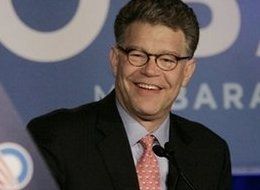
Professor Michael C. Herron of Dartmouth College, has put together a new study of the voting patterns in Minnesota, in the process determining that the majority of voters who cast unrecorded ballots in the Senate race were likely Franken supporters.
"If someone put a gun to my head and said, 'You have to bet,' I would bet Franken," Herron said, when reached by phone. "It won't be a wipe-out. Two hundred votes is effectively tied. We just know that, in this case, Democrats tend to [screw up their ballots] more often [than Republicans]." In Minnesota, the "intent" of the voter is considered during recounts.
According to Herron's analysis, of the 2.9 million people who went to the polls in Minnesota, there were approximately 34,000 residual voters in the Senate race. In other words, there were 34,000 more ballots cast than total number of recorded votes for all the Senate candidates.
Why the difference? A good portion of voters, Herron concludes, voted in the presidential election but deliberately did not vote for a Senate candidate. These people won't matter when it comes to a recount.
There is, however, a portion of the 34,000 who intended to vote for one of the Senate candidates but messed up. Voters were supposed to fill in the circle next to the name of the candidate they supported. Some, however, marked X's. Others circled the name itself or crossed out the names of candidates they didn't like.
This group is key to determining the Minnesota Senate victor.
Monday, November 17, 2008
GOODBYE TO ALL THAT...AND GOOD RIDDANCE
by: Paul Waldman, The American Prospect

President Bush with Cabinet members. (Photo: Ron Edmonds / AP)
After eight years of President Bush, we almost don't know how to function without him - almost. But before we move on, we should pause to remember just what we're leaving behind.
Just over two years into George W. Bush's presidency, The American Prospect featured Bush on its cover under the headline, "The Most Dangerous President Ever." At the time, some probably thought it a bit over the top. But nearly six years later, it's worth taking a moment to reflect on the multifaceted burden that will soon be lifted from our collective shoulders.
Since last week, I have stopped short and shaken my head in amazement every time I have heard the words "President-elect Obama." But it is equally extraordinary to consider that in just a few weeks, George W. Bush will no longer be our president. Let me repeat that: In just a few weeks, George W. Bush will no longer be our president. So though our long national ordeal isn't quite over, it's never too early to say goodbye.
Goodbye, we can say at last, to the most powerful man in the world being such a ridiculous buffoon, incapable of stringing together two coherent sentences. Goodbye to cringing with dread every time our president steps onto the world stage, sure he'll say or do something to embarrass us all. Goodbye to being represented by a man who embodies everything our enemies want the people of the world to believe about America - that we are ignorant, cruel, and only care about foreign countries when we decide to stomp on them. Goodbye to his giggle, and his shoulder shake, and his nicknames. Goodbye to a president who talks to us like we're a nation of fourth-graders.
And goodbye, of course, to Dick Cheney. Goodbye to the man whose naked contempt for democracy contorted his face to a permanent sneer, who spent his days in his undisclosed location with his man-sized safe. And while we're at it, goodbye to Cheney's consigliore David Addington, as malevolent a force as has ever left his trail of slime across our federal institutions.
Goodbye, indeed, to the entire band of liars and crooks and thieves who have so sullied the federal government that belongs to us all. We can even say goodbye to those who have already gone, to Rummy and Scooter, to Fredo and Rove, tornados of misery left in their wake.
Goodbye to the rotating cast of butchers manning the White House's legal abattoir, where the Constitution has been sliced and bled and gutted since September 11. Goodbye to the "unitary executive" theory and its claims that the president can do whatever he wants - even snatch an American citizen off the street and lock him up for life without charge, without legal representation, and without trial. Goodbye to the promiscuous use of "signing statements" (1,100 at last count) to declare that the law is whatever the president says it is, and that he'll enforce only those laws he likes. Goodbye to an executive branch that treats lawfully issued subpoenas like suggestions that can be ignored. Goodbye to thinking of John Ashcroft as the liberal attorney general. Goodbye to the culture of incompetence, where rebuilding a country we destroyed could be turned over to a bunch of clueless 20-somethings with no qualifications save an internship at the Heritage Foundation and an opposition to abortion. Goodbye to the "Brownie, you're doin' a heckuva job" philosophy, where vital agencies are turned over to incompetent boobs to rot and decay. Goodbye to handing out the Medal of Freedom as an award for engineering one of the greatest screw-ups of our time. Goodbye to an administration that welcomed gluttonous war profiteering, that was only too happy to outsource every government function it could to well-connected contractors who would do a worse job for more money.
Goodbye to the Bush Doctrine of preemptive war. Goodbye to the lust for sending off other people's sons and daughters to fight and kill and die just to show your daddy you're a real man. Goodbye to playing dress-up in flight suits, goodbye to strutting and posing and desperate sexual insecurity as a driver of American foreign policy. Goodbye to the neocons, so sinister and deluded they beg us all to become fevered conspiracy theorists. Goodbye to Guantanamo and its kangaroo courts. Goodbye to the use of torture as official U.S. government policy, and goodbye to the immoral ghouls who think you can rename it "enhanced interrogation techniques" and render it any less monstrous.
Goodbye to the accusation that if you disagree with what the president wants to do, you don't "support the troops."
Goodbye to stocking government agencies with people who are opposed to the very missions those agencies are charged with carrying out. Goodbye to putting industry lobbyists in charge of the agencies that are supposed to regulate those very industries. Goodbye to madly giving away public lands to private interests. Goodbye to a Food and Drug Administration that acts like a wholly owned subsidiary of the pharmaceutical industry, except when it acts like a wholly owned subsidiary of the fundamentalist puritans who believe that sex is dirty and birth control will turn girls into sluts. Goodbye to the "global gag rule," which prohibits any entity receiving American funds from even telling women where they can get an abortion if they need it.
Goodbye to vetoing health insurance for poor children but rushing back to Washington to sign a bill to keep alive a woman whose cerebral cortex had liquefied. Goodbye to the ban on federal funding of embryonic stem-cell research.
Goodbye to the philosophy that says that if we give tax cuts to the rich and keep the government from any oversight of the economy, prosperity will eventually trickle down. Goodbye to the thirst for privatizing Social Security and to the belief that the success of a social safety-net program is what makes it a threat and should mark it for destruction. Goodbye to the war on unions and to a National Labor Relations Board devoted to crushing them. Goodbye to the principle of loyalty above all else, that nominates Harriet Miers to the Supreme Court and puts Alberto Gonzales in charge of the Justice Department. And goodbye to that Justice Department, the one where U.S. attorneys keep their jobs only if they are willing to undertake bogus investigations of Democrats timed to hit the papers just before Election Day. Goodbye to a Justice Department where graduates of Pat Robertson's law school roam the halls by the dozens, where "justice" is a joke.
Goodbye to James Dobson and a host of radical clerics picking up the phone and hearing someone in the White House on the other end. Goodbye to the most consequential decisions being made on the basis of one man's "gut," a gut that proved so wrong so often. Goodbye to the contempt for evidence, to the scorn for intellect and book learnin', to the relentless war on science itself as a means of understanding the world.
Goodbye, goodbye, goodbye to it all.
Though President Obama will be spending most of his time cleaning up the mess George Bush made, we probably won't have Dubya to kick around anymore. It's hard to imagine Bush undertaking some grand philanthropic effort on the scale of the Clinton Global Initiative, or hopping around to international trouble spots like Jimmy Carter. Republicans won't be asking him to speak on their behalf, and publishers are reportedly uninterested in the prospect of a Bush memoir. His reign of destruction complete, Bush will return to Texas and fill his days with the mundane activities of a retiree - puttering around the yard, reading some magazines, maybe enjoying that new Xbox Jenna gave him for Christmas ("I'm the Decider, and I decide to spend this afternoon playing Call of Duty 4").
This presidency is finally over. We can say goodbye to an administration whose misdeeds have piled so high that the size of the mountain no longer shocks us. In our lifetimes, we will see administrations of varying degrees of competence and integrity, some we'll agree with and some we won't. But we will probably never see another quite like the one now finally reaching its end, so mind-boggling a parade of incompetence and malice, dishonesty, and immorality. So at last - at long, long last - we can say goodbye.
And good riddance.
--------
Paul Waldman is a senior fellow at Media Matters for America and the author of "Being Right is Not Enough: What Progressives Must Learn From Conservative Success." The views expressed here are his own.
Subscribe to:
Posts (Atom)


